DC power transmission and distribution technology has become a research hotspot in recent years due to its superior characteristics across various aspects. As a key equipment in DC power grids, DC transformers have also garnered extensive attention. Regarding DC transformer topologies, replacing traditional line-frequency isolation transformers with high-frequency isolation transformers is widely regarded as an inevitable development trend for next-generation high-frequency isolated power conversion technology in smart grids.
Due to the large size and complex structure of high-voltage high-capacity power electronic devices used in power grids, direct experimental research is often infeasible. Additionally, their construction cycles are lengthy, and costs are high. With the advancement of computer technology, advanced digital model simulation has gradually become a crucial research tool in power electronics and power system–related fields. The use of digital simulators can effectively reduce development cycles and testing costs while achieving test environments difficult to realize in practical scenarios.
Real-time simulation of structural characteristics of DC transformers is a critical issue in their technological development. The primary challenges lie in establishing small time-step models, capturing high-frequency switching signals, and enabling flexible topological transformation and expansion. Leveraging the concept of the eHS solver and utilizing FPGA's capabilities for rapid computation and reconfigurable mapping, a DC transformer model simulation with a time step below 1 microsecond is achieved.
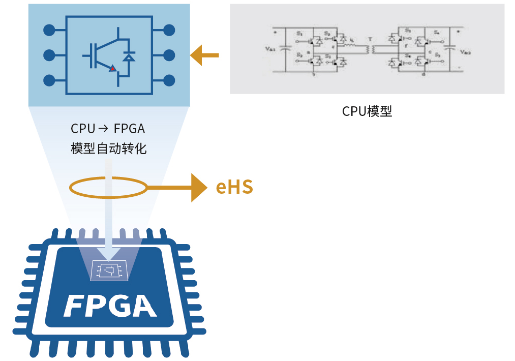
On-chip FPGA simulation for DC transformers leverages FPGA's rapid computation and reconfigurable mapping capabilities. Using the eHS graphical tool, it automatically converts power electronics topologies from the CPU to the FPGA for solving, and feeds the computation results back to the CPU in real-time for display.

Fig.1 System schematic
■ eHS is a graphical modeling tool that does not require FPGA programming languages.
■ When modifying power electronics topologies, eHS eliminates the need to regenerate FPGA code, significantly reducing development time.
■ The eHS solver employs a fixed admittance matrix-based nodal method for circuit computation, ensuring model stability at simulation steps below 1 microsecond.
■ The eHS solver seamlessly integrates with RT-LAB's state-space nodal algorithm.
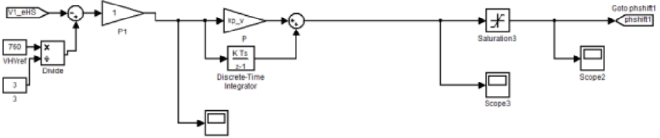
In a flexible DC distribution network system at an Electric Power Research Institute, the DC transformer adopts a two-layer control scheme. The upper-layer controller is implemented in the CPU, where the phase shift angle is calculated through traditional PI control. This approach leverages the advantages of the existing PI controller model in the CPU architecture, as illustrated in the figure below.

Fig.2 Upper-Level Control Algorithm Model
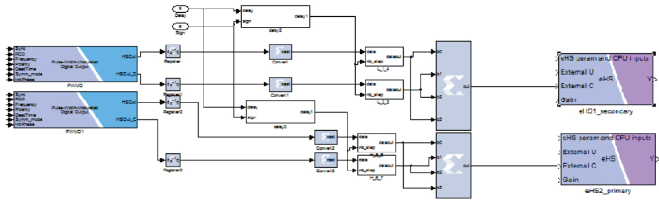
The low-level controller, specifically the three-level PWM generators for both the power supply side and the load side, is implemented in the FPGA. This approach meets simulation precision requirements while also improving simulation speed.


Fig.3: Low-Level Control Algorithm Model
DC Transformer Main Body Simulation
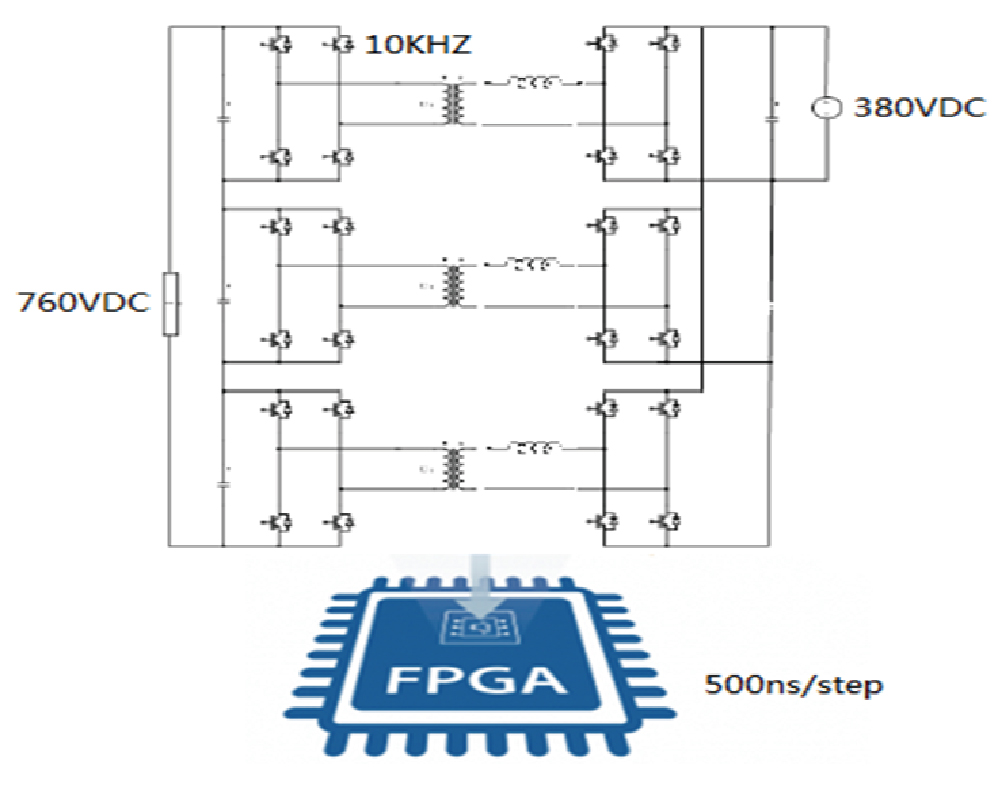
As a critical component in flexible DC distribution networks, the DC transformer in this project adopts a bidirectional full-bridge topology. The high-voltage side features three full bridges in series, while the low-voltage side uses three full bridges in parallel. It employs fixed low-side voltage control, with the bidirectional full bridges driven by single-phase-shift modulation at a switching frequency of 10 kHz. The system's rated power is 30 kW.

Fig.4: Simulation of DC Transformer
DC Distribution Network Protection Relay Testing and Protocol Communication
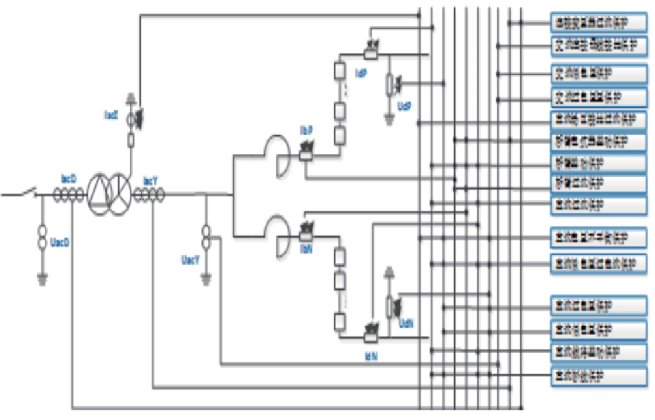
The testing evaluates the entire system's fault-clearing capability through comprehensive simulation analysis. It proposes a protection zoning scheme for DC distribution systems and protection configuration schemes for various fault types. Additionally, it enhances the technical design of control-protection prototypes based on a dynamic simulation & testing platform for DC distribution. Collaboration with a protection relay manufacturer has led to the correction and refinement of protection strategies.

Fig.5: Relay Protection Strategy for Converter Station

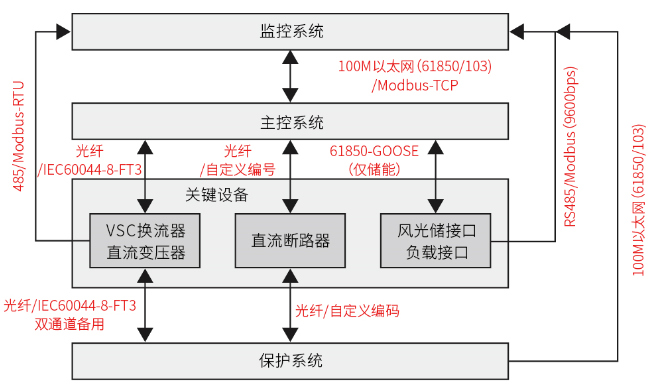
Fig.6 Overall System Interface Interaction Diagram